
Hair transplant with diffuse thinning requires more than identifying areas with reduced density. The central question is whether the scalp contains a sufficiently stable donor zone from which follicles can be moved with reasonable long-term confidence.
Diffuse thinning may be limited mainly to the top of the scalp, or it may extend into the temporal, parietal and occipital regions. The visual difference between these patterns may appear subtle, but their implications for transplantation are substantial.
Hair Transplant with Diffuse Thinning Depends on the Diagnosis
The term “diffuse thinning” describes an appearance rather than a final diagnosis. Pattern hair loss, telogen effluvium, inflammatory conditions and other forms of alopecia can all produce widespread loss of density.
This is why surgery should not precede diagnosis. Unusual shedding, scalp symptoms or reduced density outside the expected pattern may require further medical assessment. The principles discussed in hair loss diagnosis before a hair transplant are especially important when no clearly defined bald area is present.
When diffuse loss is patterned and the donor zone remains strong, selected patients may still be candidates. Grafts can be distributed between existing follicles to improve the visual effect of density. However, the plan must account for the possibility that native hair may continue to thin after the operation.
The desired recipient area also matters. A wide zone of thinning may require more grafts than the donor area can safely provide. This means that priority, rather than maximum coverage, often becomes the basis of the plan.
Stable Donor Hair Cannot Be Assumed
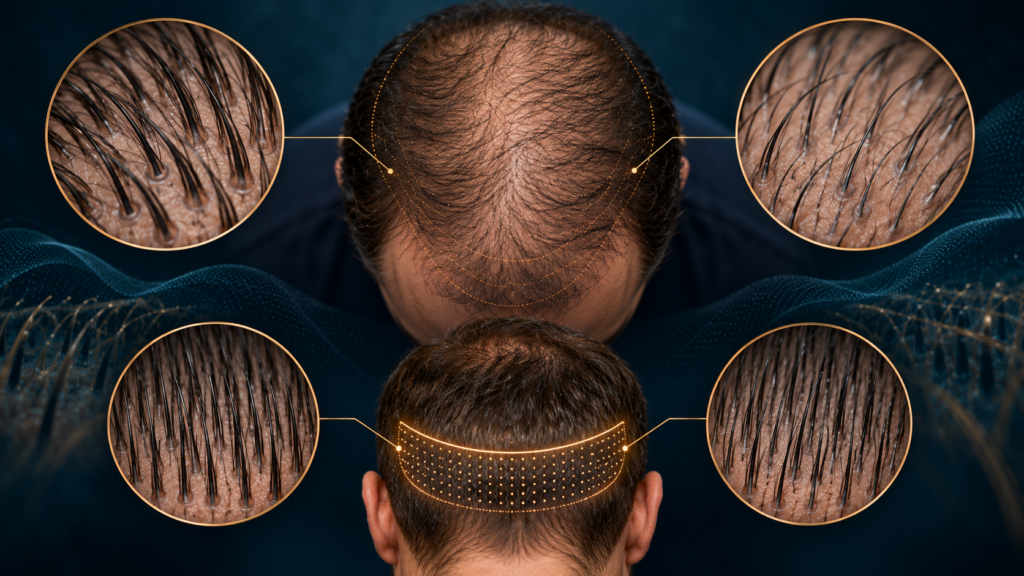
The success of a hair transplant with diffuse thinning depends heavily on whether the proposed donor follicles are resistant to the process affecting the rest of the scalp.
If miniaturisation extends into the back and sides, harvesting can create two problems. The extraction pattern may become visible as donor density declines, and the transplanted follicles may not provide the expected long-term permanence.
The donor examination should therefore consider density, hair calibre, follicular-unit composition and signs of miniaturisation. Hair transplant guidelines recommend evaluating the safe donor area for miniaturisation before deciding how many grafts can be harvested.
A person with diffuse thinning may also have fine hair throughout the scalp. Even with acceptable graft survival, fine shafts produce less visual coverage. A conservative forecast is more useful than promising a density the available hair characteristics cannot create.
When a Limited Plan Is Better Than a Large Session
Surgery may still be possible when the donor area is stable, the diagnosis is clear and the patient understands the limits of coverage. The first session may focus on the frontal region rather than attempting to distribute grafts thinly across the entire scalp.
When donor involvement is suspected, hair loss is unstable or the required coverage exceeds the available reserve, it may be safer to postpone the hair transplant.
Diffuse thinning does not produce a universal yes-or-no answer. The difference lies in diagnosis, donor stability and the scale of the proposed operation. A broader explanation of these factors is available in hair transplant with diffuse thinning.
The correct plan is not necessarily the one that places the most grafts. It is the one that preserves a believable result as both the transplanted and existing hair change over time.