
Hair transplant with a weak donor area is often discussed as a numbers problem. A patient is told that a certain number of grafts can be extracted, and the conversation quickly moves to how those grafts will be placed.
The more important issue is what the donor area will look like after extraction and whether the follicles being removed are likely to remain stable. A graft count without this context can create a false sense of certainty.
Hair Transplant with a Weak Donor Area Is Not a Package
Donor capacity is influenced by more than the total number of visible follicles. Baseline density, hair calibre, follicular-unit composition, scalp-to-hair colour contrast and the size of the genuinely safe zone all affect what can be achieved.
Extraction also changes the appearance of the donor region. Every removed follicular unit leaves less hair behind to cover the scalp. When density is already limited, even a technically successful extraction can produce visible depletion.
The distribution of the extractions matters as much as their number. Removing grafts evenly from an appropriate zone can preserve a more homogeneous appearance. Concentrated or aggressive harvesting may create transparent patches or a moth-eaten pattern.
Miniaturisation introduces another concern. If the supposedly safe donor follicles are becoming thinner, their long-term behaviour becomes less predictable. This is closely related to the questions raised by hair transplantation with diffuse thinning.
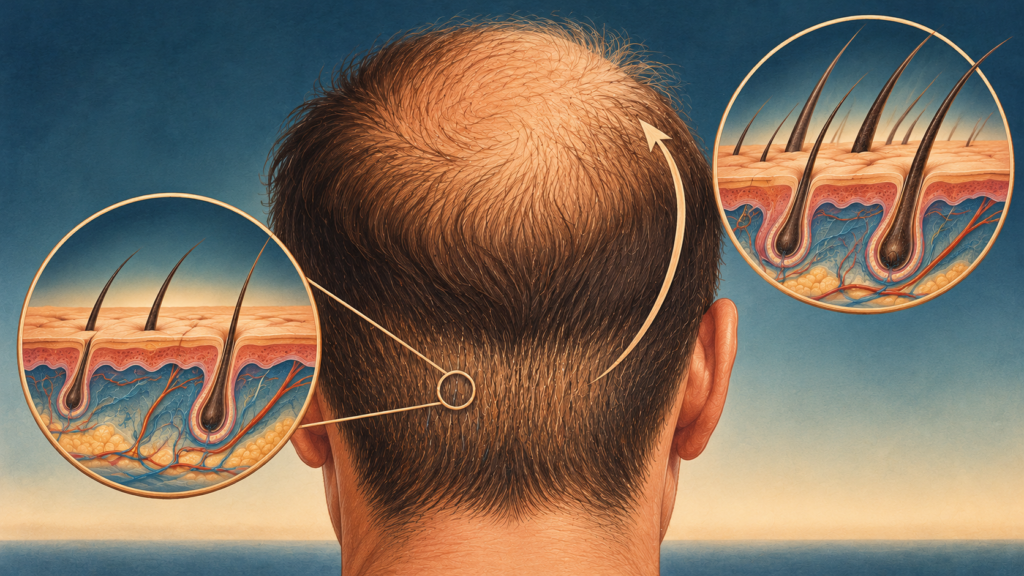
Donor Capacity Must Be Matched to the Recipient Goal
A hair transplant with a weak donor area may still be considered when the recipient goal is limited and realistic. Restoring a conservative frontal frame requires fewer grafts than attempting to cover the front, mid-scalp and crown together.
This is where a large advertised graft number can become misleading. The ability to remove more grafts does not prove that they should be removed. The donor appearance after surgery, future hair loss and possible need for another procedure must remain part of the calculation.
Hair calibre can improve or weaken the visual return from each graft. Coarse or wavy hair generally creates more coverage. Fine hair may require more follicles to create the same impression, even though the donor supply is already restricted.
Previous operations further complicate the estimate. Extraction records may not reveal the exact condition of the remaining scalp. Density must be reassessed rather than calculated only by subtracting an earlier graft count.
When Preservation Is More Valuable Than Extraction
Surgery should be questioned when no stable donor zone can be identified, existing depletion is already visible or the remaining supply cannot create a worthwhile improvement without compromising the back of the scalp.
Being a good candidate for a hair transplant does not mean having some extractable follicles. It means possessing a donor supply that can support a proportionate and durable plan.
A detailed explanation of the assessment is available in hair transplant with a weak donor area.
The responsible objective is not to reach the highest graft count. It is to use the fewest grafts capable of producing a meaningful improvement while leaving the donor area visually acceptable and useful for the future.