
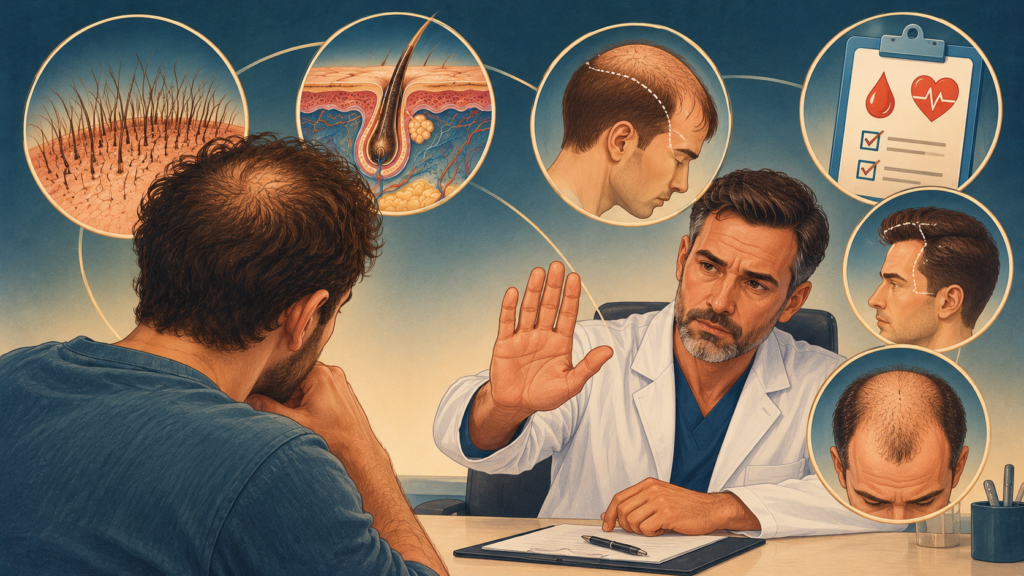
Hair transplant refusal is often interpreted as a failure to qualify for surgery. In responsible practice, however, it is a clinical decision: the available donor supply, diagnosis or likely progression of hair loss does not support the operation being requested.
The ability to extract grafts is not the same as the ability to create a durable result. Surgery must leave the patient with an acceptable donor appearance, a coherent recipient pattern and enough flexibility for future hair loss. Understanding why a clinic may refuse a hair transplant begins with this distinction.
Hair Transplant Refusal Should Follow a Complete Assessment
A refusal should not be based on age, photographs or a single density measurement alone. The assessment should examine the entire scalp, establish the diagnosis and determine whether the proposed donor zone is likely to remain stable.
Diffuse unpatterned thinning is an important example. If miniaturisation extends into the occipital and temporal scalp, follicles taken from those areas may not provide the permanence normally expected from donor hair. Active inflammatory or scarring conditions may also require dermatological investigation before surgery can be considered.
Rapidly progressing hair loss creates a different problem. A technically successful procedure may become visually isolated as surrounding native hair continues to thin. The decisions made during a hair transplant consultation must therefore account for the probable future pattern—not merely the patient’s appearance on the day of surgery.
The published review on surgical candidacy in pattern hair loss emphasises detailed history, examination and donor assessment when identifying patients for whom surgery may be inappropriate.
A Graft Number Cannot Solve a Capacity Problem
Patients with advanced hair loss frequently request simultaneous coverage of the hairline, mid-scalp and crown. Yet each additional region divides a donor supply that cannot regenerate after harvesting.
A conservative operation may still be possible when the available grafts can create a worthwhile improvement in a priority zone. But a hair transplant with a weak donor area should not proceed when even a limited plan would visibly deplete the donor region or produce negligible coverage.
Expectations must also be examined. Surgery cannot restore the scalp to its original number of hairs. Its purpose is to redistribute a limited supply in a way that creates a convincing impression of coverage. If the patient will accept only a density or area of coverage that cannot be delivered, hair transplant refusal may be more ethical than an operation followed by predictable disappointment.
Medical fitness, scalp health and psychological readiness may also influence the decision. Some issues can be managed before reassessment; others may make elective surgery inappropriate.
Refusal Is Part of Long-Term Planning
A “no” can mean that hair loss should first be stabilised, that a scalp condition needs treatment or that the surgical objective must be reduced. In such situations, postponement creates time for a safer decision.
A permanent refusal may be necessary when no stable donor zone exists or when the achievable change cannot justify the cost to the donor area.
Hair transplant refusal is not evidence that a clinic lacks a solution to sell. In some consultations, it is evidence that the clinic understands the limits of surgery and is willing to protect the patient from an operation that should not be performed.