
Good candidate for a hair transplant is not a description that can be confirmed from a single photograph. Visible baldness may establish a cosmetic concern, but it does not prove that surgery can provide a durable or proportionate solution.
Hair transplantation depends on the relationship between supply and demand. The donor area provides a limited supply of follicles. The recipient area creates the demand. Candidacy begins with determining whether those two sides can be balanced over the patient’s lifetime.
Good Candidate for a Hair Transplant: The Essential Conditions
A clear diagnosis comes first. Pattern hair loss is the most common reason for transplantation, but temporary shedding, autoimmune loss, inflammatory conditions and scarring alopecias can create very different surgical implications.
The review Deciding Surgical Candidacy in Pattern Hair Loss identifies sufficient hair loss, good donor hair, a healthy scalp, acceptable general health and reasonable expectations as central components of candidacy.
The pattern should also be sufficiently stable to support planning. Active progression does not always make surgery impossible, but it increases uncertainty. Grafts placed into the most visible area today may become isolated if the surrounding native hair continues to recede.
This is why a good candidate for a hair transplant must be evaluated in terms of future loss rather than present appearance alone. Family history, age, miniaturisation and recent progression can all influence the likely direction of the pattern.
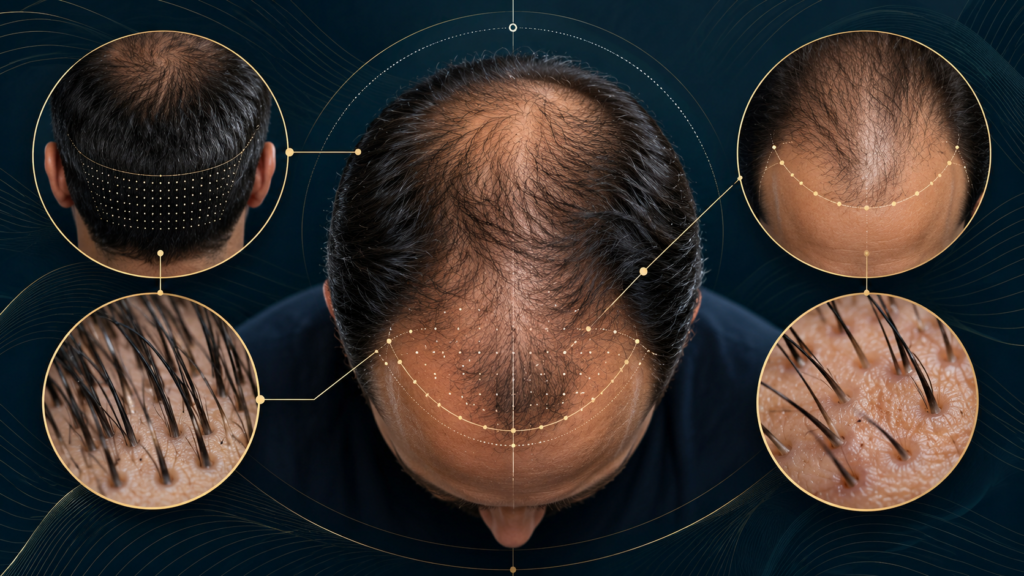
Donor quality is equally important. A dense-looking donor area may still contain fine or miniaturising follicles. Assessment should consider density, shaft diameter, follicular-unit composition and the boundaries of the region expected to remain resistant.
Candidacy Is Also About Expectations
Hair transplantation redistributes existing follicles; it does not multiply them. Even an excellent donor area cannot recreate unlimited density across a large bald surface.
A patient seeking a natural improvement may be suitable, while someone expecting complete restoration of adolescent density may not yet be ready to make an informed decision. Expectations affect hairline height, graft distribution and the number of areas that can be treated responsibly.
Candidacy also includes an understanding of progression. A person considering a procedure while natural hair is still being lost should know that transplanted follicles do not protect untreated hair around them.
Medical and psychological factors matter as well. General health, healing risks, medication use and the ability to follow postoperative instructions should be discussed appropriately. Severe anxiety, obsessive focus on small imperfections or expectations that surgery will solve unrelated personal problems may require additional caution.
The purpose of consultation is therefore not to persuade every visitor to proceed. It is to establish whether the procedure can answer the actual problem within safe and realistic limits.
Why a Good Consultation May End Without Surgery
A person may be unsuitable because the donor area is too weak, the loss is too diffuse or the scalp condition is not yet controlled. The desired coverage may also require more follicles than the donor region can safely provide.
When redness, pain, scaling, scarring or unexplained shedding is present, a dermatologist before hair transplant evaluation may be more important than choosing between FUE and DHI.
Age can introduce further uncertainty, especially when the eventual pattern is not yet visible. Postponement in such cases protects the donor area and allows the progression to be documented.
Being a good candidate for a hair transplant does not mean that every desired change is possible. It means the diagnosis, donor capacity, timing and expectations align well enough to support a result that can remain natural as the patient continues to age.
A clinic that declines surgery is not necessarily turning away a possible result. It may be preventing a result that cannot be sustained.