
Dermatologist before hair transplant assessment becomes especially important when the cause of hair loss is unclear, the loss has changed suddenly or the scalp shows symptoms beyond gradual pattern thinning. Hair transplantation redistributes follicles; it does not diagnose or control an active disease affecting them. Clarifying the condition first can change whether surgery should proceed, be postponed or be removed from the plan.
When should you see a dermatologist before a hair transplant?
Dermatologist Before Hair Transplant: Which Signs Need Attention?
A slowly receding hairline or gradually thinning crown may fit a recognisable androgenetic pattern. Even then, the diagnosis and donor area should be assessed carefully. Certain findings make dermatological evaluation more urgent:
- sudden or rapidly increasing diffuse shedding;
- smooth, round or irregular patches of hair loss;
- itching, burning, pain or tenderness of the scalp;
- redness, marked scaling, crusting or pustules;
- smooth, shiny or scar-like areas where follicular openings are difficult to see;
- loss affecting the eyebrows, eyelashes or other body hair;
- thinning that extends into the potential donor region;
- an appearance that does not fit a clear male or female pattern.
These signs do not establish a diagnosis on their own. They indicate that the loss should not be treated only as an empty area requiring grafts.
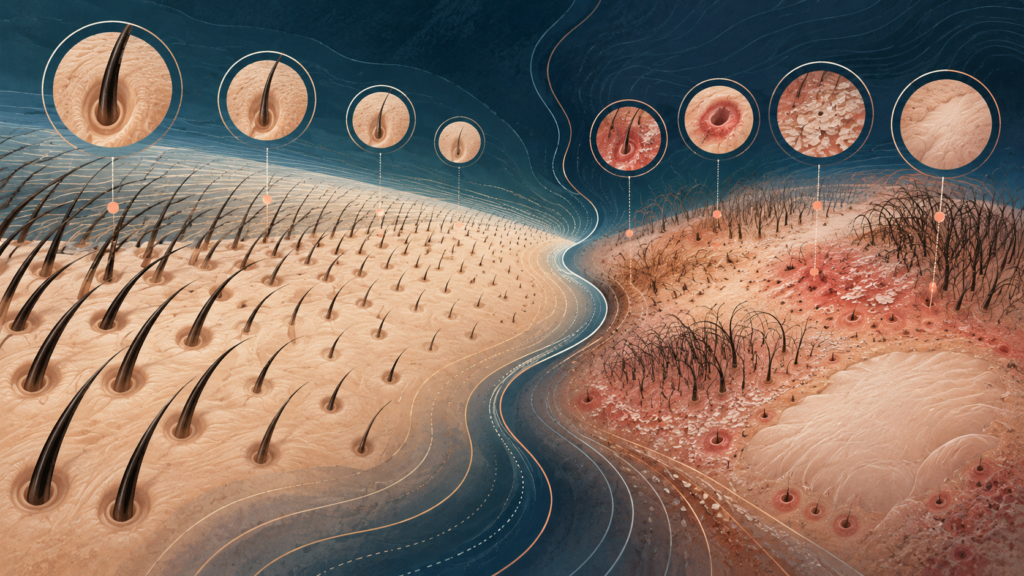
Scarring alopecias are particularly important because inflammation can permanently destroy follicles and replace them with scar tissue. Some conditions may continue to progress even after transplantation. Operating while disease activity remains uncontrolled can expose both the existing and transplanted hair to further loss.
What Can a Dermatological Assessment Include?
The assessment usually begins with the history. When did the loss start? Was it gradual or sudden? Has the patient recently experienced illness, childbirth, rapid weight loss, major stress or a medication change? Are there scalp symptoms or similar conditions in the family?
The dermatologist may examine the scalp, hair, nails and other affected areas. Magnified examination with a dermatoscope can reveal differences in shaft diameter, broken hairs, inflammation and changes around follicular openings that may not be clear in an ordinary photograph.
The American Academy of Dermatology’s guidance on hair-loss diagnosis explains that a dermatologist may also use a gentle pull test and, when the history suggests it, blood tests or a scalp biopsy. Not every patient needs every test. Investigation should be selected to answer a specific clinical question.
Referral does not delay the correct plan. It helps determine what the correct plan is.
Why Can Surgery Need to Wait?
A dermatologist before hair transplant evaluation can distinguish conditions that may recover, require treatment or remain unsuitable for surgery. Temporary shedding can improve when its trigger resolves or an underlying problem is treated. Performing surgery before recovery becomes clear may use a limited donor reserve to address an appearance that is still changing.
Active inflammatory or scarring conditions create a different concern. A transplant does not stop the process that is attacking the follicles. Disease control and a period of documented stability may be necessary before surgical suitability can even be reconsidered.
Patchy autoimmune loss, unexplained donor thinning and rapidly progressing diffuse loss can also change the decision. In some cases, transplantation may become reasonable after diagnosis and appropriate management. In others, it may remain unsuitable.
This is why the question is not simply whether grafts can technically be placed. It is whether the scalp provides a stable biological environment in which transplantation can produce a durable and responsible result.
Where Does the Hair-Transplant Consultation End?
A hair-transplant consultation should identify when the findings fall outside a straightforward surgical assessment. The specialist does not need to assign a dermatological diagnosis to recognise warning signs and recommend evaluation by the appropriate physician.
My earlier article on hair loss diagnosis before a hair transplant explains why technique selection must follow diagnosis. A dermatologist before hair transplant referral becomes part of that sequence when symptoms, distribution or progression raise questions that surgery cannot answer.
In The Hair Transplant Doctrine, I describe this as a boundary of professional responsibility. Sometimes the best contribution to a future transplant plan is to postpone it. Sometimes the assessment shows that another form of care should come first. A technically possible procedure is not automatically the correct next step.
Dermatology Assessment Before Hair Transplant: Frequently Asked Questions
Which scalp symptoms should be assessed before a hair transplant?
Why can active scarring alopecia make transplantation unsuitable?
Does every hair-transplant candidate need blood tests or a biopsy?