
Hair follicle vs. hair shaft describes the difference between the living structure beneath the skin that produces hair and the visible fibre that emerges from it. The terms are often used as though they mean the same thing, but they refer to different parts of the hair system. Understanding that distinction helps explain everyday shedding, progressive thinning, graft counts and what actually happens during a hair transplant.
What is the difference between a hair follicle and a hair shaft?
Hair Follicle vs. Hair Shaft: What Is the Structural Difference?
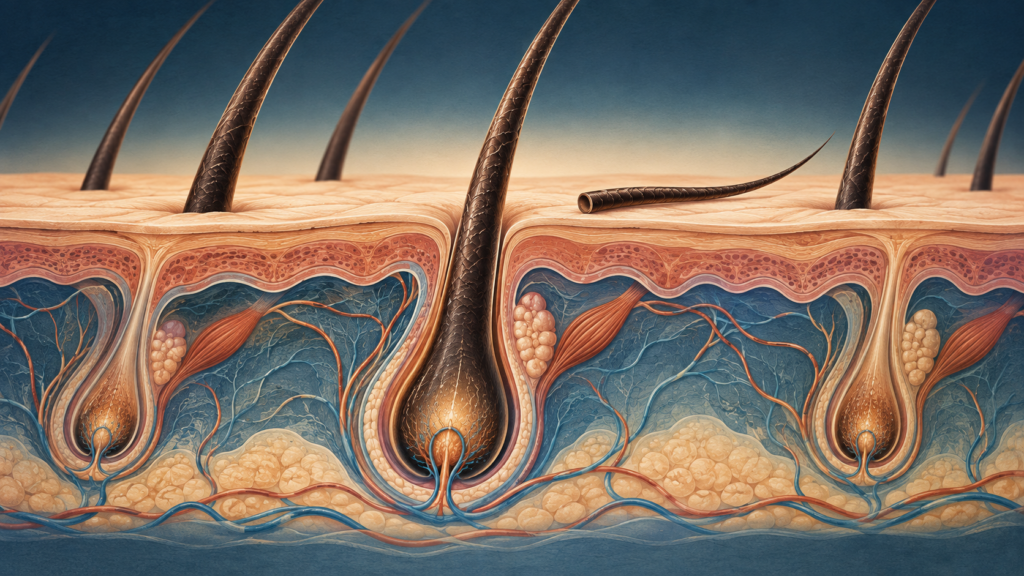
The hair shaft is the part we can see, wash, cut and style. It consists mainly of hardened, keratinised cells and has three principal layers: the cuticle on the outside, the cortex beneath it and, in some hairs, a central medulla. The cortex contributes much of the shaft’s strength, shape, colour and texture.
The follicle lies within the skin. It is a complex biological structure surrounding the hair root and working with components such as the hair bulb, dermal papilla, root sheaths, sebaceous gland and arrector pili muscle. At the base, signals and nutrients support the production of new cells that eventually form the shaft.
The Cleveland Clinic’s overview of hair follicles describes the follicle as a tube-like structure within the skin that produces a strand of hair. This is the essential distinction: the follicle is the production system, while the shaft is its visible product.
Does a Shed Hair Mean the Follicle Has Been Lost?
Usually, no. Hair grows through a repeating cycle of growth, transition, rest and shedding. At the end of a cycle, the old shaft can separate and fall while the follicle remains beneath the skin. It may then begin producing another shaft as it returns to active growth.
The small white or translucent bulb sometimes seen at the end of a shed hair is frequently mistaken for the entire follicle. Pulling out a hair shaft does not normally remove the follicular structure embedded in the skin.
What falls into the sink is not necessarily what has been permanently lost beneath the skin.
This difference also explains why counting shed hairs cannot, by itself, establish the cause or permanence of hair loss. A person can shed many shafts while the follicles retain the capacity to recover. In other conditions, follicles may gradually produce finer and shorter shafts through miniaturisation. If a follicle is permanently destroyed by a scarring process, however, regrowth may no longer be possible.
Why Is a Graft Not the Same as a Hair?
The hair follicle vs. hair shaft distinction becomes especially important when graft numbers are discussed. Hair transplantation adds another term to the discussion: the follicular unit. Scalp hairs are naturally arranged in small groups rather than distributed as completely isolated strands. A follicular unit may contain one, two, three or sometimes four hair shafts along with its supporting structures.
During a modern hair transplant, these follicular units are harvested and placed as grafts. This means that one graft does not automatically equal one hair. Two patients receiving the same number of grafts may receive different total numbers of hairs and achieve different visual coverage because hair thickness, curl, colour contrast and survival also influence the result.
Single-hair grafts are particularly useful at the frontal edge, where a soft and irregular transition supports naturalness. Units containing more hairs can contribute greater visual density behind that line. The aim is therefore not only to count grafts, but to understand what each graft contains and where it can contribute most effectively.
Why Does the Distinction Matter After a Hair Transplant?
In the weeks after transplantation, some implanted hair shafts commonly shed. This can cause concern because the patient sees the visible part disappear. The follicle may still remain beneath the skin and later produce a new shaft as the growth cycle continues.
The hair follicle vs. hair shaft distinction is equally important when assessing existing hair. A scalp can look less dense even though many follicles remain present, because those follicles are producing increasingly fine shafts. My article on androgenetic alopecia and telogen effluvium explains how progressive miniaturisation differs from excessive shedding.
In The Hair Transplant Doctrine, I emphasise that the visible hair is only part of what must be assessed. The condition of the follicles, the composition of the follicular units and the biological process affecting them all shape the plan. Once these terms are separated clearly, graft numbers, post-operative shedding and the long-term limits of transplantation become easier to understand.
Hair Follicle and Hair Shaft: Frequently Asked Questions
Is the white bulb on a shed hair the follicle?
Does one graft always contain one hair?
Why do transplanted hairs shed after surgery?