
Male vs. female hair loss assessment requires more than identifying whether the patient is a man or a woman. Hair loss often appears in different patterns, may raise different diagnostic questions and can affect the donor area in different ways. These distinctions influence whether a hair transplant is appropriate and how a long-term plan should be designed.
Why do men and women need different hair loss assessments?
Male vs. Female Hair Loss Assessment: How Do the Patterns Differ?
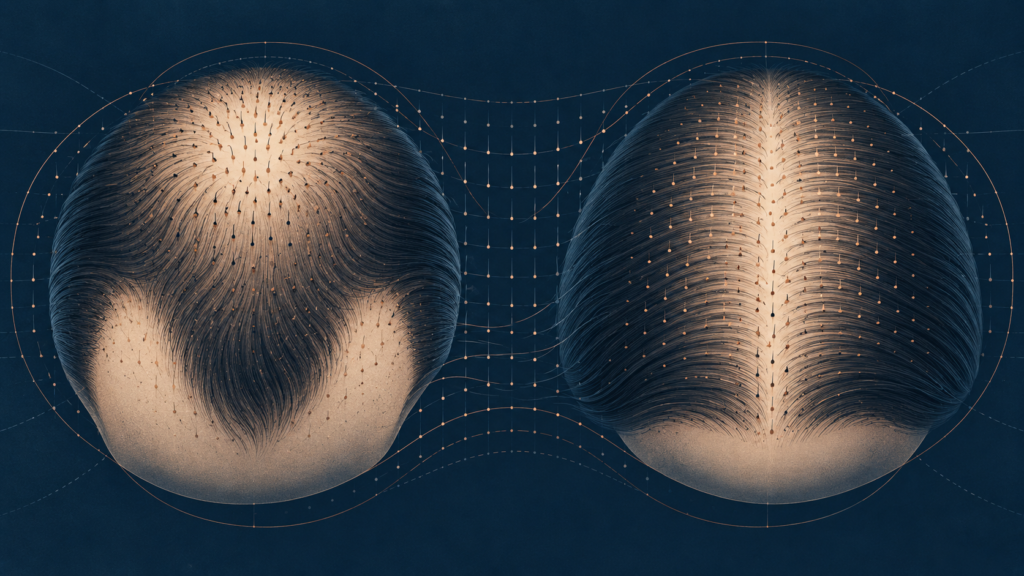
In men with androgenetic alopecia, recession at the temples, movement of the frontal hairline and thinning at the crown are common. The Hamilton–Norwood classification describes this progression in stages, from limited temporal recession to advanced loss connecting the frontal and crown areas.
Women more often retain the frontal hairline while density decreases across the top and central scalp. A widening part or a thinner ponytail may be noticed before a clearly bald area develops. The Ludwig classification describes female-pattern hair loss from early part widening to more visible diffuse thinning.
These patterns are useful maps, but they are not complete diagnoses. A woman can develop temporal recession, and a man can experience diffuse loss. Sudden shedding, patchy loss, scalp inflammation or thinning outside the expected pattern should not be forced into a male or female classification.
The American Academy of Dermatology’s guidance on female-pattern hair loss also emphasises that other causes can resemble this condition and should be ruled out before treatment is selected.
Why Can the Medical History Require a Different Emphasis?
Every assessment should examine timing, progression, family history, medications, nutrition, recent illness and scalp symptoms. The emphasis may change according to the patient’s presentation.
In women, diffuse thinning or increased shedding may occur alongside childbirth, menopause, iron deficiency, thyroid disorders or other hormonal and systemic factors. Irregular menstrual cycles, acne or increased facial and body hair can provide additional reasons for medical investigation. These possibilities do not mean that every woman with thinning hair has a hormonal disorder. They mean the history should guide whether further assessment is necessary.
Men with a typical pattern can also have another cause of hair loss at the same time. Rapid diffuse shedding, smooth patches, pain, redness, marked scaling or loss extending into the usual donor region may indicate that the problem should be assessed beyond androgenetic alopecia.
A familiar pattern can guide the examination, but it should not replace the examination.
This is why a male vs. female hair loss assessment should remain individual. The aim is to identify the process affecting the follicles rather than attach a standard plan to the patient’s gender.
How Does the Donor Area Change the Transplant Decision?
Hair transplantation depends on a stable and sufficiently strong donor area. In many men with pattern loss, the sides and back of the scalp may provide a more clearly defined zone of relatively resistant hair. Its density, shaft thickness and degree of miniaturisation still need to be measured rather than assumed.
Some women with female-pattern hair loss have diffuse thinning that also affects potential donor areas. If follicles at the back and sides are miniaturising, moving them may not provide the durable coverage expected from transplantation. Diffuse thinning does not automatically exclude surgery, but it makes donor assessment especially important.
Hairline design also follows different starting points. A man may require reconstruction of a receded frontal frame while preserving enough grafts for future crown or mid-scalp loss. A woman may retain the frontal border and need carefully distributed density behind it. The natural direction, calibre and existing hairs within the recipient area all affect placement.
Why Is Classification Alone Not Enough?
Two men at the same Norwood stage can have different donor density, head size, hair-shaft thickness and rates of progression. Two women at the same Ludwig stage can differ in shedding history, donor stability and the number of miniaturised hairs that remain.
A classification records the visible pattern. It cannot determine a graft number, predict future loss or establish surgical suitability by itself.
My earlier article on hair loss diagnosis before a hair transplant explains why cause and progression must be understood before technique selection. In practice, a male vs. female hair loss assessment brings the same principle into a more specific context: similar-looking thinning can arise from different processes and place different demands on the donor area.
In The Hair Transplant Doctrine, I treat classifications as a shared language rather than a ready-made treatment plan. The final decision should reflect the individual scalp, history, expectations and future pattern—not simply the letter or number assigned to a chart.
Male and Female Hair Loss Assessment: Frequently Asked Questions
How does male-pattern hair loss usually appear?
How does female-pattern hair loss usually appear?
Can diffuse thinning affect hair-transplant suitability?