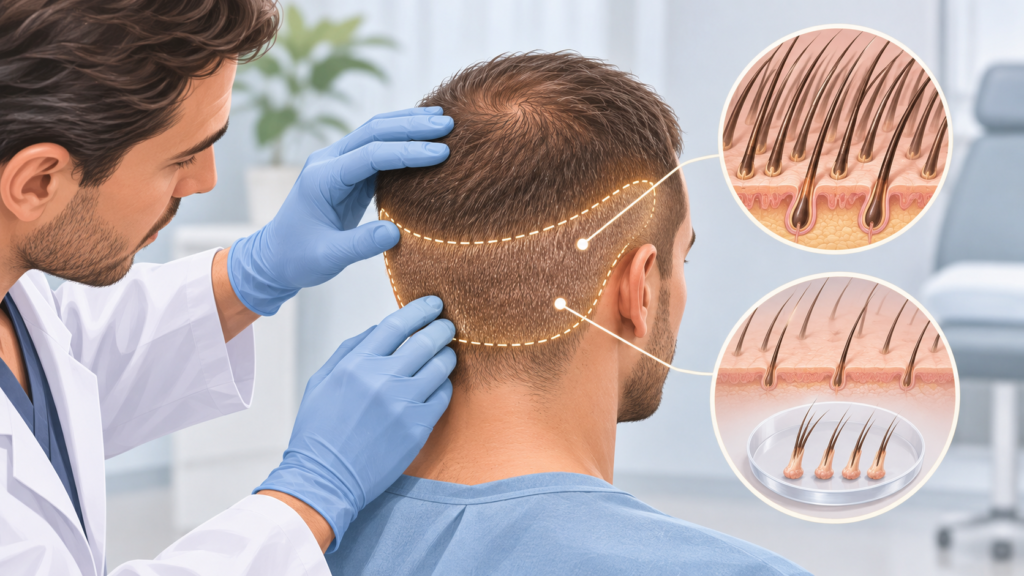
Hair transplant donor area places a firm biological limit on every restoration plan. A surgeon can redistribute suitable follicles, but cannot manufacture new ones. Once a follicular unit has been removed from the donor region, the original density of that location is permanently reduced.
This makes donor planning more important than the graft number advertised for a single session. The relevant question is not simply how many grafts can be extracted today. It is how many can be removed while maintaining an acceptable donor appearance and preserving enough stable hair for the patient’s possible future needs.
Hair Transplant Donor Area Has Both Numerical and Visual Limits
Donor density is often expressed as the number of follicular units within a measured area. That number is useful, but it does not fully describe the donor’s cosmetic capacity.
One follicular unit may contain a single hair, while another may contain two, three or more. Hair shaft diameter also influences coverage. Coarse or curly hair can create greater visual volume than fine, straight hair, even when the numerical density is similar.
Colour contrast matters as well. Dark hair against pale skin may reveal spaces between the remaining hairs more clearly than a low-contrast combination. The patient’s usual hair length must also be considered because short hairstyles make FUE extraction points and reduced density easier to see.
Safe harvesting therefore requires more than a total graft estimate. The pattern of extraction should be distributed across the appropriate zone, with adequate spacing between neighbouring sites. Repeated concentration in the same section can create visible windows and irregular patches even when the overall graft count does not initially appear excessive.
Published hair transplant practice guidelines recommend evaluating density at multiple points, hair calibre, miniaturisation and the individual boundaries of the safe donor area. These factors cannot be replaced by a standard graft package.
Future Hair Loss Changes the Meaning of Today’s Graft Count
Androgenetic hair loss is progressive. The recipient area visible during the first operation may not represent the full area that will eventually require support.
A patient may initially request a dense, low hairline. If natural hair later recedes through the mid-scalp and crown, the remaining donor reserve must be sufficient to maintain a visually coherent transition. Using most of the stable grafts in the frontal centimetres can restrict those future options.
This is why the donor calculation should occur during a full hair transplant consultation, before a technique or session size is selected. Age, family history, current miniaturisation, previous operations and the likely extent of future loss all influence the budget.
A hair transplant with a weak donor area may still be possible when a limited number of grafts can create a meaningful improvement in a priority area. It becomes unsuitable when extraction would visibly damage the donor region or when the available supply cannot support the requested coverage.
The individual nature of these limits is also central when assessing whether a weak donor area can support transplantation. The objective must follow the available reserve rather than a predetermined graft target.
Successful Planning Preserves More Than Grafts
Large graft numbers can sound impressive, but a high number is not automatically evidence of a better operation. A procedure should be judged by how effectively each graft is used and by what remains after the extraction is complete.
The donor region should retain an even, natural appearance. Its boundaries should not become obvious when the hair is shortened, and the plan should not depend on harvesting unstable peripheral follicles merely to reach a predetermined number.
Hair transplant donor area is best understood as a lifetime reserve. Every extraction has an opportunity cost: the graft cannot be used again, and the donor location will not return to its former density.
Responsible surgery therefore aims for efficiency rather than maximum extraction. The objective is to achieve meaningful coverage today without spending the patient’s entire donor budget on a single version of the future.