
Safe donor area in hair transplantation is often presented as a permanent band across the back and sides of the scalp. This description is useful as a basic concept, but it can become misleading when the same boundaries are applied to every patient.
Hair within the traditional donor region is generally more resistant to androgenetic alopecia. Resistance, however, is not distributed evenly across every occipital and temporal follicle.
The central donor zone may remain stable while hair near the neck, ears, crown or anterior temporal borders becomes progressively thinner. If these unstable follicles are extracted, their apparent availability can create an exaggerated graft estimate.
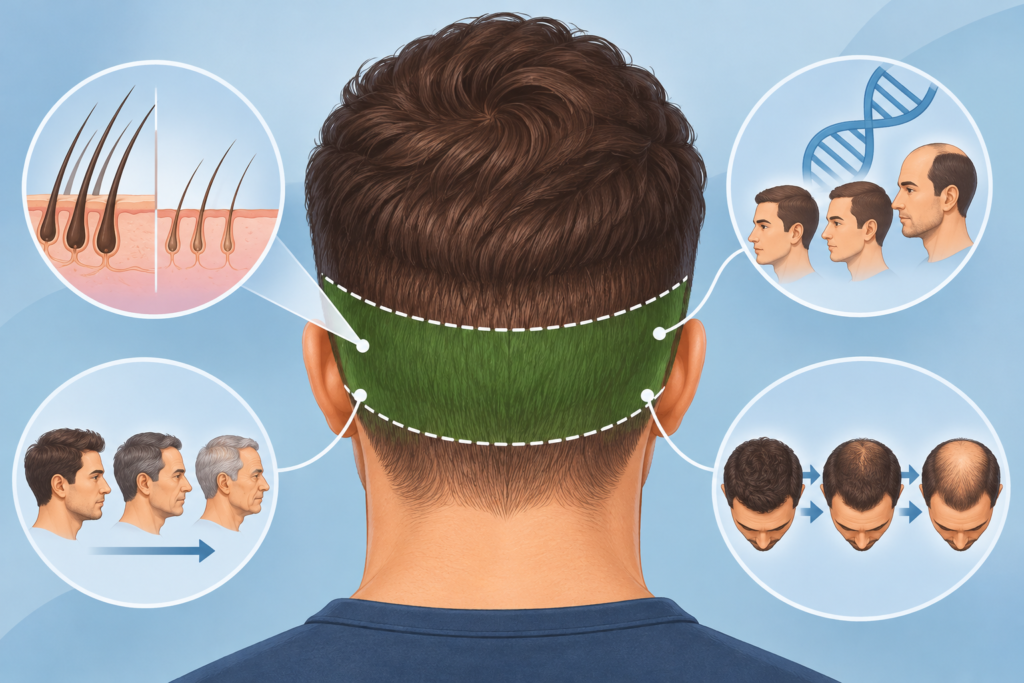
Safe Donor Area in Hair Transplantation Is a Dynamic Zone
Classical templates describe anatomical areas that are likely to remain stable in a large proportion of patients. They are conservative reference points, not guarantees of permanence.
Actual donor boundaries depend on the position of the occipital fringe, the distribution of miniaturisation and the patient’s likely future pattern of hair loss.
Retrograde thinning can move the lower boundary upward from the neck and around the ears. Crown expansion can approach the upper donor limit from above. Diffuse unpatterned thinning may reduce stability across the occipital and temporal scalp rather than respecting a clear pattern.
These changes may not be obvious when the hair is long. Clipping selected regions and examining density transitions can reveal abrupt reductions in calibre or coverage that would otherwise remain concealed.
Trichoscopy adds quantitative information. It can identify variation in shaft diameter, follicular-unit density and signs of miniaturisation across several donor points. It may also reveal findings that suggest a diagnosis other than straightforward patterned hair loss.
A contemporary review on dynamic and patient-specific donor zones recommends beginning with a conservative core and treating peripheral areas as conditional rather than universally permanent.
A Safe Boundary Must Account for the Future
The donor zone should not be defined solely by the patient’s current appearance. Age, speed of progression and family history influence how cautiously its boundaries should be drawn.
A young patient with early-onset hair loss and relatives with advanced patterns may require a narrower harvesting zone. Using uncertain peripheral follicles to increase the first-session graft count could leave transplanted hair unstable and the remaining donor fringe visibly depleted.
Previous procedures also change the calculation. Old extraction points, strip scars and uneven harvesting reduce the amount of untouched tissue. Repeated removal from already weakened sections may create visible windows even when the new session uses a modest number of grafts.
This is why the hair transplant donor area should be treated as a lifetime budget. The safe zone defines where that budget can be obtained, while the extraction strategy determines how long it can remain useful.
Patients with a weak donor area may have both a smaller stable zone and reduced density within it. In such cases, reducing the recipient objective can be safer than expanding donor boundaries to reach a predetermined number.
The patient-specific factors behind the safe donor area in hair transplantation should therefore be explained before a graft target or surgical method is selected.
Conservatism Protects Both Sides of the Operation
Peripheral hair near the nape or ears may sometimes be used selectively, particularly when finer grafts are needed for soft transitions. This does not make those areas universally safe.
Their inclusion should depend on the individual pattern, trichoscopic findings and a clear understanding of the long-term uncertainty. When the evidence is weak, the boundary should remain conservative.
Safe donor area in hair transplantation is not the largest region that contains hair today. It is the region most likely to continue providing stable follicles without sacrificing the appearance of the scalp from which they are taken.
A smaller but defensible donor zone is more valuable than a larger zone built on assumptions that may not survive the progression of hair loss.