
Does donor hair grow back after FUE? A follicular unit that has been completely removed does not normally regenerate at its original donor site.
The donor area can still look considerably fuller several months after surgery. This improvement is primarily created by wound healing and the growth of surrounding hairs that were not extracted.
Understanding this distinction is important because the visual recovery of the donor region should not be interpreted as restoration of its original follicular density.
Does Donor Hair Grow Back After FUE Extraction?
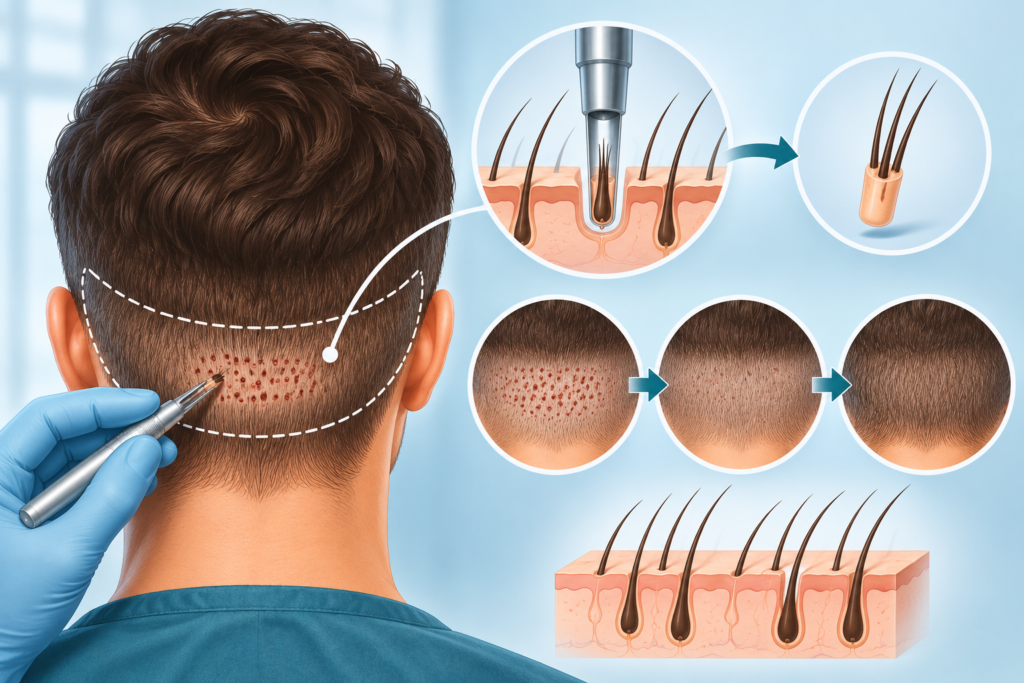
Standard FUE removes individual follicular units through multiple small circular openings. Each extracted unit is transferred to the recipient area, leaving behind an extraction site that heals as a small scar.
Once the follicular structure has been removed, the donor site no longer contains the same hair-producing unit. Healing closes the opening, but does not create a replacement follicle.
The appearance changes because the hair surrounding the site continues to grow. Longer shafts overlap the extraction points and reduce the visibility of the scalp. When removal has been distributed evenly, this camouflage can be highly effective.
The effect depends on the original donor density, hair calibre, curl, colour contrast and the length at which the patient wears the hair. Coarse or wavy hair may hide a reduction more effectively than fine, straight hair.
The ISHRS explanation of FUE donor-area regrowth confirms that removed donor hair is not replenished. The finite nature of the supply is therefore a central limitation of hair transplantation.
Not Every Hair Lost After Surgery Was Extracted
Donor-site effluvium can cause temporary shedding of residual hairs within or near the harvesting zone. These hairs were not removed as grafts; their follicles remain in the scalp.
Surgical trauma and temporary disturbance of the hair cycle can cause their shafts to fall. The resulting patchy or diffuse thinning may appear several weeks after surgery and can make the donor area look more depleted than the extraction pattern alone would suggest.
A review of FUE donor-site complications reports that donor effluvium generally resolves as affected follicles return to active growth.
This regrowth comes from retained follicles. It is biologically different from the supposed regeneration of completely extracted follicular units.
Partial transection can also leave follicular tissue in the donor scalp. Depending on the injury level, some retained structures may produce hair. However, the outcome is not sufficiently predictable to be treated as donor regeneration, and the extracted graft may be compromised.
The surgical objective should remain the clean extraction and survival of suitable grafts rather than relying on partial injury to replace the donor supply.
A Healed Donor Area Still Has Fewer Follicles
A natural-looking result is possible when extractions stay within the individual’s safe donor area and are distributed without creating concentrated gaps.
A healed donor region may show minimal redness, little visible scarring and good coverage at the patient’s usual hair length. It nevertheless contains fewer follicular units than it did before the procedure.
This is why the hair transplant donor area must be managed as a non-renewable lifetime reserve. Future procedures can only use the stable follicles that remain.
A more detailed patient-focused explanation of whether donor hair grows back after FUE also depends on separating extracted follicles from temporary donor shedding.
Does donor hair grow back after FUE? Completely removed follicles do not. The appearance improves because the scalp heals, surrounding hair grows and temporarily shed hairs may return.
The success of donor management is therefore not measured by whether the area appears to regenerate. It is measured by whether the original plan removed an appropriate number of grafts while preserving natural coverage for the long term.