
Donor area overharvesting describes visible or cosmetically significant depletion caused by removing more follicular units than the remaining donor hair can conceal.
It is commonly associated with very large FUE sessions, but the total graft count is only part of the problem. A moderate number of grafts can still create damage if extractions are concentrated, repeated in previously depleted sections or extended into unstable zones.
The relevant limit is therefore individual. It depends on the density, surface area and visual coverage capacity of the patient’s donor region.
Donor Area Overharvesting Can Occur Without an Extreme Graft Count
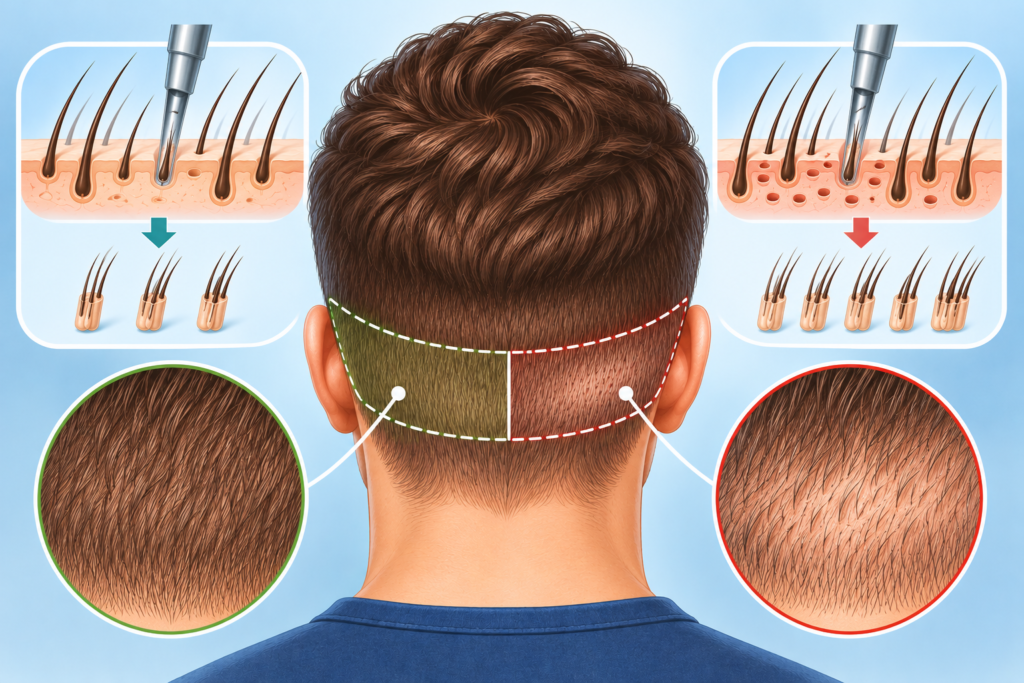
Every FUE extraction permanently reduces follicular-unit density at that point. When sites are separated and distributed evenly, the remaining hair can continue to cover the scalp.
Concentrated extraction creates a different outcome. If too many adjacent units are removed from a restricted section, the spaces may merge visually and form a low-density window.
Multiple depleted sections can produce the irregular moth-eaten appearance associated with poor donor management.
The baseline characteristics of the patient determine how much reduction becomes visible. Fine, straight hair provides less camouflage than coarse or curly hair. Strong contrast between hair and skin reveals the scalp more easily. Very short hairstyles expose density differences and pinpoint scars that longer hair may conceal.
Previous surgery must also be included. A section that appears available may already contain numerous FUE extraction points or a strip scar. Reusing it without measuring the residual density can create depletion after a relatively small additional session.
A review of FUE complications and overharvesting identifies inadequate donor assessment, high graft demands, repeated harvesting and low baseline density among the major risk factors.
Prevention Begins Before the First Extraction
A safe plan requires density measurements across several donor points rather than one representative section. Hair calibre, hairs per follicular unit, miniaturisation, scalp visibility and preferred hairstyle should also be considered.
The boundaries of the safe donor area determine where stable grafts are most likely to be found. Expanding beyond those boundaries to reach a promised number may increase future instability.
The broader hair transplant donor area must also be treated as a lifetime reserve. A session that leaves no reasonable capacity for future progression may be too aggressive even when the immediate donor appearance seems acceptable.
Early postoperative photographs cannot confirm overharvesting. Shaved hair, redness, crusting and temporary donor effluvium may exaggerate thinning. Assessment should be repeated after healing and adequate hair growth, using comparable length and lighting.
Persistent scalp visibility, patchy depletion, sharp density transitions and exposed extraction marks may indicate a lasting problem.
A patient-focused explanation of donor area overharvesting should therefore distinguish early postoperative appearance from permanent depletion.
Repair Options Are Limited
Further scalp FUE should be approached cautiously. Removing additional grafts without a new assessment can enlarge depleted areas and reduce the possibility of future correction.
Longer hair may camouflage mild thinning. Scalp micropigmentation can reduce visible contrast in selected patients. Limited transplantation into donor defects may sometimes be considered using carefully selected scalp, beard or body grafts.
None of these options recreates the original follicles. The article on whether donor hair grows back after FUE explains why healing can improve the appearance without restoring the original density.
Donor area overharvesting is consequently more predictable to prevent than to repair. A lower graft count used efficiently is often more valuable than a larger session that improves the recipient area by sacrificing the source.